
This page explains the differences between a feedback control and a feedforward control and also compares the advantages of each.
- Feedback control is a control based on actual conditions. Works after an error occurs.
- Feedforward control is a control based on prediction. Works before an error occurs.
- Feedback control is superior in most basic performances.
- However, feedforward control is better in response speed.
- It is best to combine the two and take advantage of both.
What is Feedback Control?
Feedback control is a control method that obtains actual conditions in real-time and decides on control inputs based on them.
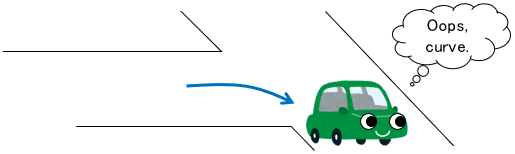
An analogy to explain this would be driving a car while keeping track of surrounding conditions.
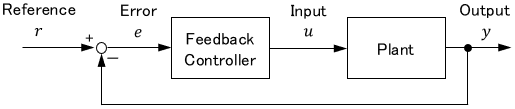
A general block diagram of feedback control is shown below.
Note: If you are not familiar with how to read the block diagram, please refer to this page:

Feedback control is also called closed-loop control because a closed loop is created in the block diagram by the arrow that feeds back the output signal.
Since feedback control is based on real-world conditions, it has the advantage of being able to suppress the effects of disturbances and modeling errors. Disturbances and errors are almost always present in the real world, so feedback is practically almost necessary.
What is Feedforward Control?
Feedforward control is a control method that determines control inputs without obtaining actual conditions but by predicting system behavior based on a model.
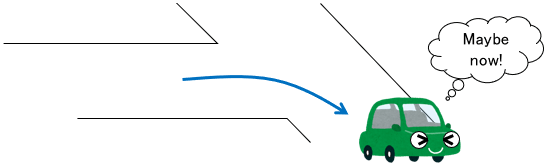
An analogy to explain this would be driving a car with eyes closed while predicting the surrounding conditions.
A general block diagram of feedforward control is shown below.

Because there is no feedback on the output signal, there is no loop in the block diagram. Therefore, feedforward control is also called open-loop control.
This sounds very dangerous, doesn’t it? Because the actual situation is not checked, it has the disadvantage of being very much affected by disturbances and errors.
However, feedforward control is also used very commonly in practice. Specifically, it is often used to control phenomena whose conditions cannot be directly obtained. For example, a cheap rice cooker cannot ascertain the condition of the rice at all times, so it cooks rice in a preset way (while predicting the condition).
Comparison of Feedback and Feedforward Control

Uh-huh. Well, we can use feedback control anyway, right?
That’s actually true. However, it is interesting to note that this does not mean feedback control is upwardly compatible with feedforward control. Let me explain in detail.
A comparison of feedback and feedforward control performance is shown in the table below.
| Feedback | Feedforward | |
|---|---|---|
| Stability | Good | Fair |
| Tracking Accuracy | Good | Fair |
| Response Speed | Good | Excellent |
| Response to Disturbances | Good | Poor |
| Response to Characteristic Changes | Good | Poor |
Note: For details of each evaluation criterion, please refer to this page:

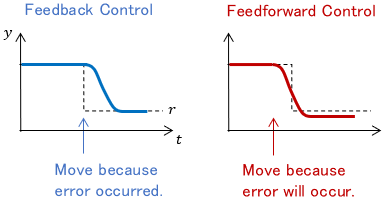
Feedback control is superior in most basic performances. But feedforward control has excellent response speed. This is because feedforward control makes predictions that feedback control does not.
More specifically, feedback control works after an error occurs between the reference and the output. On the other hand, feedforward control can be interpreted as working before the error occurs by predicting the future.
After all, the combination is the strongest
It is not necessary to choose between feedback and feedforward control. In other words, it is possible to combine them and get the best of both advantages. In fact, most advanced controllers in practice are configured that way.
The following block diagram is an example of a simple controller that combines feedback and feedforward control.
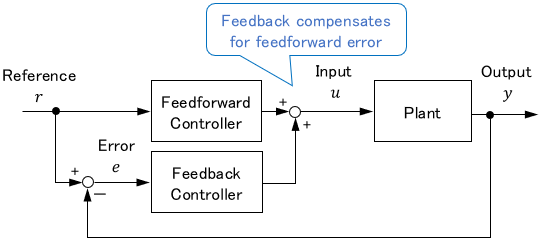
You can see that the upper half of the block diagram is for feedforward control and the lower half is for feedback control.
Keep in mind that if the desired performance cannot be achieved by feedback control alone, it can be improved by combining it with feedforward control!

- Feedback control is a control based on actual conditions. Works after an error occurs.
- Feedforward control is a control based on prediction. Works before an error occurs.
- Feedback control is superior in most basic performances.
- However, feedforward control is better in response speed.
- It is best to combine the two and take advantage of both.
Comments